
OpenAI Realtime API alternative
Voiced NPCs without building the voice stack
The OpenAI Realtime API is a speech-to-speech model you wire into your own stack. Neocortex is the character around the model: designed in an editor, voiced, and in Unity, Unreal, Godot or the web through our SDKs.
- Free plan
- No credit card
- Unity, Unreal, Godot, Web SDK and Web API

5
ways to integrate
Unity, Unreal, Godot, Web SDK, Web API
20+
languages
set per character
10 s
to clone a voice
or design one from text
€0
to start
free plan and editor testing
Powered by Industry Leaders








Overview
What is OpenAI Realtime API?
The OpenAI Realtime API gives developers direct access to OpenAI's speech-to-speech models, with function calling, over WebRTC in the browser, WebSocket from a server or SIP for phone calls. Pricing is public and per token, with a mini model for lower cost, and official SDKs cover JavaScript, Python, .NET, Java, Go and Ruby.
The short answer
OpenAI Realtime API or Neocortex: which fits your game?
Side by side
OpenAI Realtime API vs Neocortex: feature comparison
The facts that matter when you put AI characters in a game.
| Compared on | OpenAI Realtime API |  Neocortex |
|---|---|---|
| What it is | A speech-to-speech model API | Complete AI character platform |
| Pricing | Per 1M audio tokens: $32 in, $64 out on gpt-realtime-2.1, $10 and $20 on the mini model, plus text tokens | Free plan; paid plans from €9/month with monthly credits |
| Engine SDKs | No Unity SDK; official SDKs for JavaScript, Python, .NET, Java, Go and Ruby | Unity SDK, Unreal plugin, Godot, Web SDK, Web API |
| Sessions | Capped at 60 minutes; reconnect logic and a client secret server are yours to build | Each player turn is a separate request |
| Character design | Prompts in code | Visual node editor: personality, emotion, knowledge, intents, actions |
| Voice | Ten built-in voices; custom voices for eligible customers through sales | Streaming TTS and STT, voice cloning from a 10-second sample, voice design |
| Gameplay hooks | Function calling you wire to your game | Actions, interactable objects, per-line emotions |
| Voices in one scene | Voice is locked for a session once it has produced audio | Group Chat: up to six characters, each with its own voice (Pro and Team) |
What it is
OpenAI Realtime API
A speech-to-speech model API
Neocortex
Complete AI character platform
Pricing
OpenAI Realtime API
Per 1M audio tokens: $32 in, $64 out on gpt-realtime-2.1, $10 and $20 on the mini model, plus text tokens
Neocortex
Free plan; paid plans from €9/month with monthly credits
Engine SDKs
OpenAI Realtime API
No Unity SDK; official SDKs for JavaScript, Python, .NET, Java, Go and Ruby
Neocortex
Unity SDK, Unreal plugin, Godot, Web SDK, Web API
Sessions
OpenAI Realtime API
Capped at 60 minutes; reconnect logic and a client secret server are yours to build
Neocortex
Each player turn is a separate request
Character design
OpenAI Realtime API
Prompts in code
Neocortex
Visual node editor: personality, emotion, knowledge, intents, actions
Voice
OpenAI Realtime API
Ten built-in voices; custom voices for eligible customers through sales
Neocortex
Streaming TTS and STT, voice cloning from a 10-second sample, voice design
Gameplay hooks
OpenAI Realtime API
Function calling you wire to your game
Neocortex
Actions, interactable objects, per-line emotions
Voices in one scene
OpenAI Realtime API
Voice is locked for a session once it has produced audio
Neocortex
Group Chat: up to six characters, each with its own voice (Pro and Team)
Competitor details checked against their own docs, pricing pages or public reporting in November 2026.
Why teams switch
Why game teams choose Neocortex over OpenAI Realtime API
The character is already built
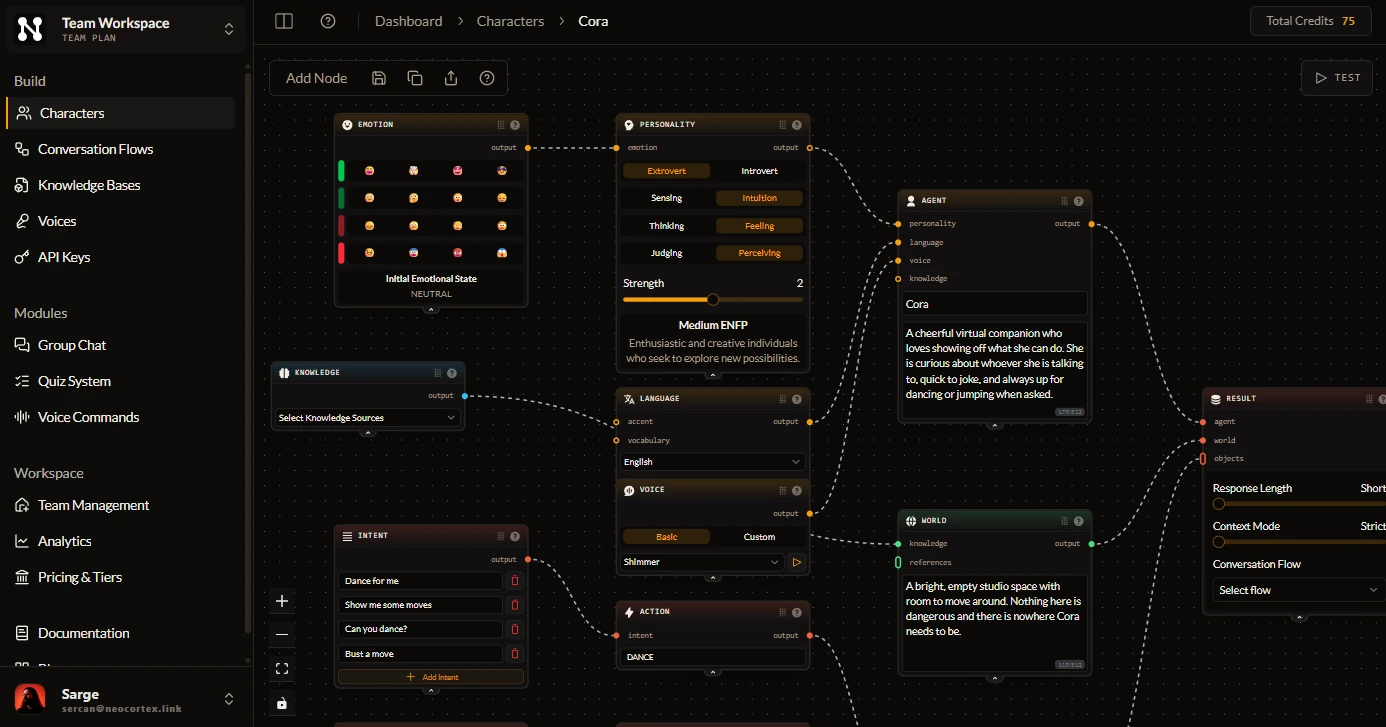
Personality, 16 emotions, knowledge, intents and actions are nodes on one screen, tested in the browser before they reach your engine.
Engine SDKs included
The Unity, Unreal and Godot SDKs handle the microphone and playback, including Unity WebGL. OpenAI ships no Unity SDK.
A monthly price
Monthly credits instead of a bill per audio token, with no cap on players. Caps per player and per character keep one heavy user in check.
Characters that act
Replies carry actions with the id of the object each one targets, such as opening a door or handing over an item, and an emotion on every line.
Voices of your own
Clone a voice from a 10-second sample or design one from a description, with lip sync in Unity, Unreal and Godot. OpenAI limits custom voices to eligible customers.
Your key stays on your server
For browser games, the Web SDK adds a small server proxy, so the browser never sees your API key.
How it works
Characters you design, not prompts you babysit
- Personality, emotion, knowledge and world are nodes you connect, not prompts you rewrite.
- Intents and actions turn what a player says into something your game does.
- Test every character in the browser for free before it reaches your engine.
What Our Customers Say
Discover what creators are saying about building with Neocortex.

FAQ
OpenAI Realtime API alternative: common questions
Want the long version? Read the in-depth OpenAI Realtime API comparison.
Does the OpenAI Realtime API have a Unity SDK?
No. OpenAI's official SDKs cover JavaScript, Python, .NET, Java, Go and Ruby, and Unity support comes from community libraries. Neocortex has a Unity SDK for Unity 6 with seven sample scenes, plus an Unreal plugin, a Godot SDK and a Web API.
How much does the OpenAI Realtime API cost?
It is billed per token. On gpt-realtime-2.1, audio costs $32 per million tokens in and $64 out, and text $4 in and $24 out; the mini model charges $10 and $20 for audio. Neocortex has a free plan and monthly plans from €9.
How long can an OpenAI Realtime session last?
Sessions are capped at 60 minutes, so long play sessions need reconnect logic and a way to carry context over. With Neocortex, each player turn is a separate request, so there is no long-lived connection to keep alive.
What is the best OpenAI Realtime API alternative for games?
Neocortex, if you want a finished character in your engine: a visual editor, voice cloning, actions your game executes, and SDKs for Unity, Unreal and Godot. If you want direct access to the model and plan to build the rest yourself, the Realtime API is the better fit.
Can one OpenAI Realtime session voice several characters?
Not by switching voices: once the model has emitted audio in a session, the voice cannot be changed for that session, so a cast of different voices needs more than one session. Neocortex Group Chat puts up to six characters, each with its own voice, into one scene, on the Pro and Team plans.
Does the OpenAI Realtime API remember players between sessions?
OpenAI describes a session as a stateful interaction whose responses are added to that session's conversation state, and a session lasts at most 60 minutes, so memory across sessions is yours to build. Neocortex keeps each conversation as a session you resume by its id, the engine SDKs save that id for you, and older messages are folded into a running summary.
Does the OpenAI Realtime API work with Unreal Engine or Godot?
OpenAI's official SDKs cover JavaScript, Python, .NET, Java, Go and Ruby, with no engine plugins, so an Unreal or Godot integration is yours to write. Neocortex has an Unreal plugin for Unreal Engine 5.0 and later and an open-source Godot SDK for Godot 4.7 and later.
Skip the voice NPC plumbing
Free plan, no credit card. Build a character in the browser and talk to it in minutes.

More comparisons
All comparisonsInworld AI alternative
Inworld moved its focus to voice and inference for consumer apps and retired Character Studio. Neocortex keeps character design visual, game-first and in your engine.
Convai alternative
Convai's $29 plan stops at 3,000 replies, 75 players a month and one conversation at a time. Neocortex puts no cap on players or simultaneous conversations, for games, VR, XR and training.
NVIDIA ACE alternative
NVIDIA ACE is an on-device toolkit for Unreal Engine 5 and RTX GPUs. If you build in Unity, ship to mobile or the web, or lack a C++ team, Neocortex gets you a talking character today.
Charisma.ai alternative
Charisma.ai's website now redirects to Charismatic Studio, an AI production studio, and its docs and app no longer load. Join Neocortex today: rebuild your characters in a visual editor, share them with anyone through a public link, and ship them in Unity, Unreal, Godot and on the web.
Player2 alternative
With Player2, every player signs in to Player2 and spends their own credits, and NPCs stop answering when those run out. Neocortex keeps your players inside your game.
ElevenLabs Agents alternative
ElevenLabs Agents is a voice pipeline for web, mobile and phone. Games need more: a stable SDK in every engine you ship, characters that act, and costs that do not grow with every minute of play.
Hume EVI alternative
Hume ended its EVI and TTS APIs on November 13, 2026, and its EVI documentation now points to the new Audio Decisions API. Neocortex gives your characters a new home with voice in and out.
Replica Studios alternative
Replica Studios closed on June 30, 2025, and its API went offline. Neocortex gives you character voices again, plus NPCs that listen and answer.