7 Best Avatar Creators and Avatar SDKs for Games in 2026
The best avatar creators and avatar SDKs for games in 2026: seven tools compared on engines, file formats, face rigs, licences and price.
Neocortex TeamThe team behind Neocortex
· 11 min read
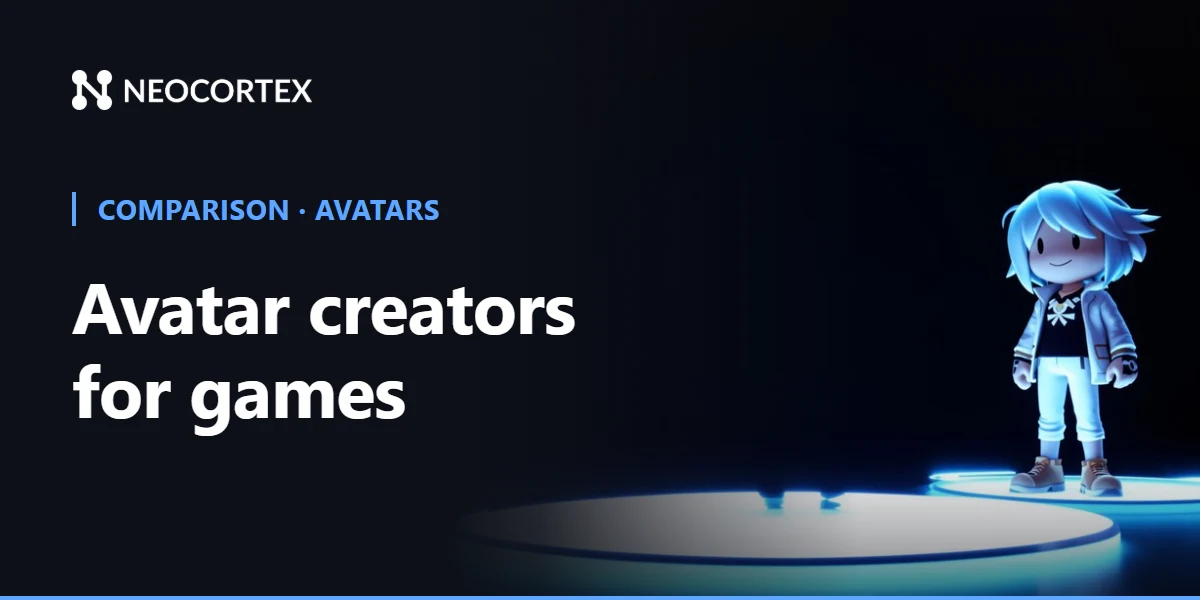
The best avatar creators for games in 2026 fall into two groups. Avatar SDKs put an avatar creator inside your game, so players can build their own: Avaturn, Avatar SDK, Genies and the Meta Avatars SDK. Avatar makers are desktop tools your team uses to build characters before release: VRoid Studio, Character Creator 5 and MetaHuman. This list covers all seven.
One name is missing on purpose. Ready Player Me, for years the default avatar SDK for games, closed on 31 January 2026 after Netflix bought it. If you are replacing it, read our guide to Ready Player Me alternatives, which also covers what to do with avatars you already exported.
This post is for game and app developers picking an avatar tool. It covers the five points we judged each tool on, a table of all seven, an entry for each with its limits and price as read on the vendor's site in November 2026, and a guide to picking one. Neocortex, our own product, is not on the list. It does not make avatars. It gives an avatar a voice, lip sync and a mind once the avatar exists, and we say how at the end.
What to look for in an avatar creator for games
We judged every tool on the same five points.
- Who creates the avatar. An avatar SDK runs inside your game and lets each player make a look of their own, often from a selfie. An avatar maker is for your artists, who make a fixed set of characters. Pick the group first.
- Engine support. Check for an SDK, plugin or documented import path for your engine and your target platforms. Some SDKs cover WebGL and mobile but not desktop builds.
- File format and rig. GLB (glTF 2.0) and FBX load in most engines. VRM is a glTF-based format made for humanoid avatars, with its own expressions and licence fields; see our post on VRM avatars. A standard humanoid rig lets you reuse animation libraries such as Mixamo.
- Face rig. A character that speaks needs mouth shapes in the exported file. Look for the 52 ARKit blendshapes or a viseme set, and check which one your lip sync tool reads.
- Price and licence. SDKs charge per avatar or by usage, often monthly. Desktop tools charge for the software. Read what the licence allows for a commercial game, and whether it changes with your revenue.
The shortlist at a glance
Prices as listed on each vendor's site in November 2026.
| Tool | Type | Style | Engines | Face rig | Starting price |
|---|---|---|---|---|---|
| Avaturn | Avatar SDK | Realistic, from a selfie | Web, Unity, Unreal, iOS, Android | ARKit blendshapes and visemes | Basic plan free; Pro $800 a month |
| Avatar SDK (MetaPerson) | Avatar SDK | Realistic, from a selfie | Unity, Unreal, web, iOS, Android | 14 visemes plus a laugh shape | First avatar free; Pro $800 a month |
| Genies | Avatar SDK | Stylized | Unity; iOS, Android, web in early access | Not listed | Usage based |
| Meta Avatars SDK | Avatar SDK | Meta avatars | Unity, Meta ecosystem | Quest Pro face tracking | Not listed |
| VRoid Studio | Avatar maker | Anime | Any engine with a VRM loader | VRM vowel expressions | Free |
| Character Creator 5 | Avatar maker | Realistic or stylized | Unity, Unreal, Blender, Maya | Facial profiles, Standard to HD | $299 perpetual |
| MetaHuman | Avatar maker | Realistic humans | Unreal Engine | MetaHuman face rig | Free under $1 million revenue |
The best avatar SDKs in 2026
1. Avaturn
Best for: games and apps where players make a realistic avatar of themselves.
Avaturn builds a 3D avatar from a single photo. The player then edits body type, hair, clothes and accessories in an editor you embed in your game or site. Avaturn says more than 10,000 looks can be made this way.
For developers, the main draw is what comes out: a GLB (glTF 2.0) file with a standard humanoid rig, ARKit blendshapes and visemes. That means Mixamo animations and ARKit-based lip sync tools can work on it without extra rigging. The docs include a converter from GLB to VRM if your app needs that format.
Avaturn lists plugins for the web, Unity, Unreal Engine, iOS and Android. In Unity, its docs name WebGL, Android and iOS builds, and ask you to get in touch for Windows and Mac standalone games.
The limits: custom branding, your own user accounts and the API for a custom editor UI are on the Pro plan, and the pricing page does not list the free plan's limits.
Pricing: Basic is free. Pro is $800 a month for up to 1,000 avatars, plus $0.15 per extra avatar. Enterprise is priced on request. See Avaturn pricing.
2. Avatar SDK (MetaPerson)
Best for: studios that want selfie avatars and the option to generate them on their own hardware.
Avatar SDK's MetaPerson Creator turns one selfie into a full-body avatar in the browser. You can embed the creator in your app or call the REST API, and there are SDKs for Unity, Unreal Engine, the web, iOS and Android.
Avatars export as GLB, glTF or FBX with a humanoid rig that takes Mixamo animations. For speech, MetaPerson avatars carry a set of 14 visemes plus a laughter shape, and the docs include setup guides for SALSA LipSync in Unity and Oculus Lipsync in Unity and Unreal. ARKit blendshapes are not mentioned in the docs we read; custom blendshapes are an Enterprise option.
On the Enterprise plan, avatar generation can run on your device or servers ("local compute") at the same pricing as the cloud. That matters for kiosks, events and games that cannot send player photos to a third party.
The limits: Pro is only open to companies under $2 million in revenue for the past 12 months and under $2 million raised.
Pricing: The first avatar in MetaPerson Creator is free. Pro is $800 a month for 1,000 avatars, then $0.03 each, with up to 25% off for annual billing and a free 7-day API trial. See Avatar SDK pricing.
3. Genies
Best for: stylized avatars in Unity, from a vendor that also sells AI behaviour.
Genies makes stylized 3D characters, wearables and props from text prompts or photos, and its Unity SDK is live. Genies describes it as a customizable character system for player characters and NPCs, with animation.
Genies also pitches avatars with memory, voice and their own behaviour, so it overlaps with AI character tools as well as avatar tools. Its iOS, Android and web SDKs are in early access, and a REST API is listed as coming soon.
The limits: the developer page names no file formats, publishes no prices and does not mention Unreal Engine or Godot.
Pricing: Usage based, across interactions and asset generation, with no revenue share. No figures are published. See the Genies developer page.
4. Meta Avatars SDK
Best for: Unity VR apps on Quest that want the avatars players already use across Meta's apps.
The Meta Avatars SDK lets a Unity VR app show Meta's customizable avatars, with packaged presets and user-made avatars. On Quest Pro it uses eye and face tracking for more natural expressions.
The limits: the SDK has reached end-of-feature status. Meta says version 40.0.1 is the final release and no new features are planned, though existing apps keep working, the backend stays up and you can still build and submit apps. The docs we read cover Unity only and do not state a price or licence. For more on characters in headsets, see our post on AI NPCs in VR.
Pricing: Not stated on Meta's overview page. See the Meta Avatars SDK overview.
More options: avatar makers for your art team
These three are for making characters ahead of time. Players do not use them in your game.
5. VRoid Studio
Best for: anime-style characters on no budget.
VRoid Studio is pixiv's free character maker for Windows and macOS. You build a character from presets and sliders, and draw hair and textures by hand with a pen tool. It exports VRM, and since July 2025 new models export as VRM 1.0 by default, with VRM 0.0 still available.
VRM files load in Unity through UniVRM, in Unreal Engine through VRM4U, in Godot through godot-vrm and on the web through pixiv's three-vrm. Each VRM file carries the creator's own terms, including whether commercial use is allowed, and VRoid Studio lets you set them for every model you make.
The limits: the style is anime. The VRM standard defines five vowel shapes and a few emotions for the face, and the 52 ARKit shapes are not part of it, so check the model before you use an ARKit-based lip sync tool.
Pricing: Free. See VRoid Studio on Steam.
6. Character Creator 5
Best for: teams that need many realistic or stylized characters for Unity or Unreal Engine.
Reallusion's Character Creator 5 is a desktop tool for making and editing characters, with exports for iClone, Maya, Blender, Unreal Engine, Unity and other 3D tools. It writes FBX, OBJ and USD, and Reallusion offers auto-setup add-ons for Unreal Engine and Unity. Facial profiles go from Standard up to HD.
The limits: licensing has two layers. Reallusion's content licence lets you export content to any game engine, but asks for an Extended License for some Character Creator components (avatars, hair, cloth) used on characters in games and apps sold widely. Read it before you ship. We compare it with Epic's tool in Character Creator 4 vs MetaHuman.
Pricing: $299 for a perpetual licence (on sale for $179.40 when we checked), or Character Creator 365 at $8.25 a month billed yearly. Free 30-day trial. See Reallusion's store.
7. MetaHuman
Best for: realistic human characters in Unreal Engine games.
MetaHuman Creator ships inside Unreal Engine 5.6 and later, and it needs an internet connection while you author, because rigging and texture work run as cloud services. The result is a realistic human with Epic's full face and body rig.
Epic's licence lets MetaHumans be used with any engine. It is free for anyone making under $1 million a year; above that, rendering MetaHumans outside Unreal Engine needs a seat licence at $1,850 per seat per year.
The limits: the export tool writes Unreal assets and DNA files, not FBX or glTF for Unity or Godot, so a MetaHuman outside Unreal takes real work. See MetaHuman in Unity and Godot.
Pricing: Free under $1 million in annual revenue. See MetaHuman licensing.
Picking the right avatar creator for your game
- Players make an avatar from a selfie, in a web, mobile or WebGL game: Avaturn.
- Players make an avatar from a selfie, and photos must stay on your servers: Avatar SDK, on the Enterprise plan.
- Stylized player avatars in a Unity game: Genies.
- A Unity VR app for Quest where players bring their Meta avatar: the Meta Avatars SDK, knowing it gets no new features.
- Anime characters, no budget: VRoid Studio.
- A cast of characters for a Unity or Unreal game: Character Creator 5.
- Realistic humans in Unreal Engine: MetaHuman.
Whichever you pick, the avatar is a body and a face. To make it hold a conversation, it needs a mind, a voice and a mouth that moves with the words. That is the part Neocortex covers. You build the character's personality, knowledge, emotions and actions in a node editor, and talk to it from Unity, Unreal Engine, Godot or the web, with voice in and out. Lip sync runs on ARKit-style mouth shapes through the Face Animator in Unreal Engine and Godot, and the Unity sample drives blendshape face animation from the reply audio. See what that looks like on a 3D character on our interactive avatars page, or get started.
For the steps after the avatar, our AI 3D character pipeline covers generating, rigging and voicing a model, and Mixamo alternatives covers rigging and animation.
Frequently Asked Questions
What is the best avatar creator for games?
For avatars that players make inside your game, Avaturn and Avatar SDK are the closest replacements for Ready Player Me. For characters your team makes, VRoid Studio is the free option for anime style and Character Creator 5 the option for realistic or stylized casts.
What is an avatar SDK?
An avatar SDK is a kit that puts an avatar creator inside your game or app. Players build or scan their avatar there, and your code loads the result as a rigged 3D model.
Is there a free avatar creator?
Yes. VRoid Studio is free, Avaturn has a free Basic plan, and Avatar SDK lets you make your first MetaPerson avatar for free. MetaHuman is free for anyone making under $1 million a year.
What happened to Ready Player Me?
Netflix bought it in December 2025, and its avatar creator, PlayerZero and developer API closed on 31 January 2026.
Which format should a game avatar use?
GLB or FBX for most engines, and VRM if players will bring avatars from other VRM apps. Whatever the format, check that the file has a humanoid rig and the mouth shapes your lip sync tool reads.
Can I make my avatar talk?
Yes, if the avatar has mouth blendshapes. Add a voice and a conversation system, then drive the mouth from the audio. Our guide to AI lip sync for game characters explains the options.